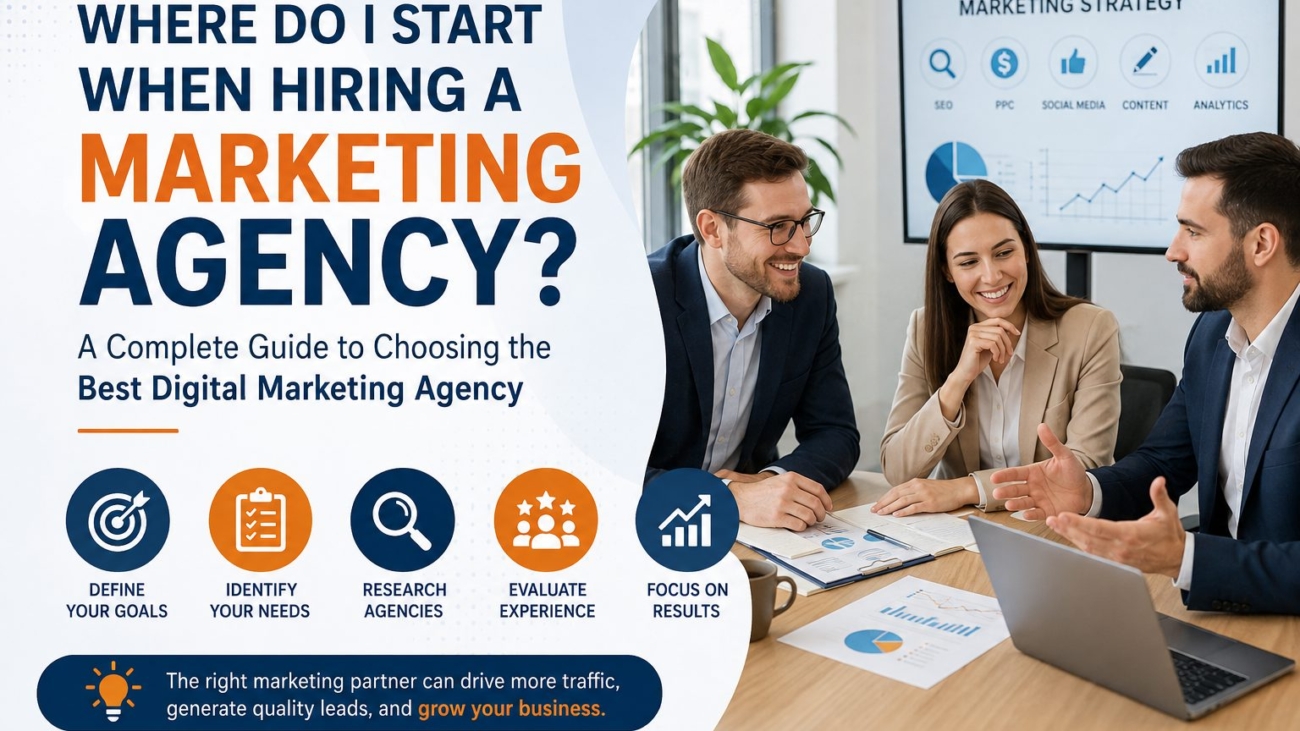
Where Do I Start When Hiring a Marketing Agency?
Hiring a marketing agency can be a major decision for any business. Whether you are a startup building your online presence or an established company looking for more leads and sales, choosing the best digital marketing agency can have a significant impact on your growth.
With so many digital marketing agencies offering SEO, PPC, social media marketing, content marketing, web design, and other online marketing services, knowing where to start can be difficult.
If you are searching for the best digital marketing agency for your business, don’t choose an agency based only on its Google ranking or the lowest price. Instead, understand your goals, determine which services you need, research potential agencies, and compare their experience, strategies, results, and communication.
This guide will help you understand how to choose the best digital marketing agency for your business.
1. Define Your Marketing Goals
Before contacting a digital marketing agency, clearly define what you want your marketing campaigns to achieve.
Your goals might include:
- Increasing website traffic
- Generating qualified leads
- Increasing online sales
- Improving Google rankings
- Building brand awareness
- Growing social media accounts
- Reducing cost per lead
- Increasing website conversions
- Launching a new product or service
- Reaching a new market
The more specific your goals are, the easier it becomes for a marketing agency to create the right strategy.
For example, instead of saying, “I want more marketing,” you could say:
“I want to generate 50 qualified leads per month from organic search within six months.”
A professional digital marketing company can then build its SEO, content, advertising, and conversion strategy around that objective.
2. Determine Which Digital Marketing Services You Need
You don’t necessarily need every service offered by a digital marketing agency.
The right agency should recommend services based on your business goals instead of trying to sell you every available service.
Common digital marketing services include:
Search Engine Optimization (SEO)
SEO helps your website appear higher in search engine results for relevant keywords. An experienced SEO agency can improve technical SEO, on-page optimization, content, internal linking, and other areas that can help increase organic visibility.
Pay-Per-Click Advertising (PPC)
PPC allows businesses to advertise on platforms such as Google and pay when users click on their ads. A skilled digital marketing agency can manage keyword research, advertisements, landing pages, tracking, and campaign optimization.
Social Media Marketing
Social media marketing helps businesses build awareness, engage their target audience, and generate traffic or leads through relevant social platforms.
Content Marketing
Content marketing involves creating useful blog posts, guides, case studies, videos, and other content that attracts and educates potential customers — including formats like influencer marketing content.
A good online marketing agency can use content to support SEO, build authority, answer customer questions, and generate qualified website traffic.
Email Marketing
Email marketing helps businesses nurture leads, communicate with customers, promote products, and encourage repeat purchases.
Conversion Rate Optimization
Driving visitors to your website is only part of digital marketing. Conversion rate optimization focuses on improving landing pages, forms, calls to action, and the overall user experience to turn more visitors into leads and customers.
You may need one service or a combination of several services. The best digital marketing agency for your business will recommend a strategy based on your audience, competition, budget, and objectives.
3. Set a Realistic Digital Marketing Budget
Your budget should be established before you start comparing marketing agencies.
Digital marketing costs vary depending on the services required, industry competition, business size, target market, and campaign objectives.
Instead of asking only:
“What is the cheapest marketing agency?”
ask:
“What level of investment makes sense for the results I want to achieve?”
For example, a local business may have very different marketing requirements from an e-commerce company competing across the country.
A realistic budget also helps a digital marketing company create a proposal that fits your business.
Remember that the cheapest agency isn’t always the best digital marketing agency. You should compare the expected value, experience, strategy, and scope of work rather than price alone.
4. Research the Best Digital Marketing Agencies
Once you understand your goals, services, and budget, create a shortlist of potential agencies.
You might search for:
- Best digital marketing agency
- Best digital marketing company
- Digital marketing agency near me
- SEO agency
- SEO company
- PPC agency
- Online marketing agency
- Digital marketing company for small businesses
- Full-service digital marketing agency
However, don’t choose an agency simply because it appears at the top of Google.
A company ranking highly for a keyword doesn’t automatically mean it is the best digital marketing agency for your business.
Research each agency’s:
- Website
- Services
- Portfolio
- Case studies
- Client reviews
- Industry experience
- Team expertise
- Communication process
- Reporting system
- Previous results
Your goal is to find a digital marketing agency that understands your business and can solve your specific marketing challenges.
5. Look for Relevant Digital Marketing Experience
Experience matters, but relevant experience matters even more.
For example, if you operate a B2B software company, a digital marketing agency with experience in B2B SaaS may understand your audience, sales cycle, content requirements, and lead-generation challenges better than an agency that primarily works with local restaurants.
Ask potential agencies:
- Have you worked with businesses like mine?
- Can you provide relevant case studies?
- What results did you achieve?
- What strategy did you use?
- How long did it take to see results?
- Which metrics did you track?
The best digital marketing agency should be able to explain its previous work and show how its experience could apply to your business.
6. Review Case Studies and Marketing Results
Case studies can tell you much more than a list of services.
When evaluating a digital marketing company, look for measurable outcomes such as:
- Organic traffic growth
- Keyword ranking improvements
- Lead generation
- Revenue growth
- Conversion rate improvements
- Reduced advertising costs
- Increased return on ad spend
- Improved customer acquisition
Don’t assume that another company’s results will automatically become your results.
Marketing performance depends on your industry, website, competition, budget, offer, target audience, and starting position.
A trustworthy digital marketing agency should explain how it achieved results instead of simply promising that you will receive the same numbers.
7. Ask How the Marketing Agency Measures Success
One of the most important questions to ask a marketing agency is:
“How will you measure whether my campaign is successful?”
The answer should go beyond vanity metrics.
Website traffic can be useful, but traffic alone doesn’t necessarily generate revenue.
Depending on your business, important KPIs may include:
- Qualified leads
- Sales
- Revenue
- Conversion rate
- Cost per lead
- Customer acquisition cost
- Return on ad spend
- Organic search visibility
- Keyword performance
- Customer lifetime value
Before hiring a digital marketing agency, make sure you understand which KPIs will be tracked and how often performance will be reported.
8. Understand the Agency’s Digital Marketing Strategy
Ask potential agencies what they would do during the first few months.
You don’t need a complicated strategy document before hiring a digital marketing company, but you should understand its general approach.
For SEO, an agency may evaluate:
- Technical SEO
- Keyword opportunities
- Competitor performance
- Existing content
- On-page optimization
- Internal linking
- Content development
- Authority and backlink opportunities
- Local SEO
- Reporting and measurement
For paid advertising, the process could include:
- Account and campaign analysis
- Audience research
- Keyword research
- Ad creation
- Landing-page evaluation
- Conversion tracking
- Campaign testing
- Budget optimization
- Performance reporting
The best digital marketing agency should be able to explain its strategy clearly and show why its recommended approach makes sense for your business.
9. Pay Attention to Communication
Marketing works best when the client and digital marketing agency communicate effectively.
Before hiring an agency, find out:
- Who will be your main contact?
- How often will you receive reports?
- How often will meetings take place?
- How quickly does the agency normally respond?
- Will you have access to campaign accounts?
- How are strategy changes communicated?
- Who approves website and content changes?
Strong communication is one of the most important qualities to look for when choosing the best digital marketing agency.
10. Be Careful With Unrealistic Marketing Promises
Be cautious if an agency promises guaranteed rankings, instant results, or huge returns without first understanding your business.
For example, no SEO agency can honestly guarantee a specific Google ranking indefinitely because search algorithms, competitors, markets, and search behavior can change.
SEO and other digital marketing channels often require testing, optimization, and consistent execution.
A trustworthy digital marketing agency should discuss:
- What is realistically achievable
- How long results may take
- What factors could affect performance
- What will be tested
- How success will be measured
- What happens if the strategy needs to change
Transparency is generally a better sign than aggressive promises.
11. Compare Digital Marketing Agency Proposals Carefully
After speaking with several agencies, compare their proposals carefully.
Don’t compare only the monthly price.
Look at:
| Factor | What to Consider |
|---|---|
| Services | What exactly is included? |
| Strategy | Is the strategy customized to your business? |
| Experience | Does the agency understand your industry? |
| Reporting | What will be measured and reported? |
| Communication | How often will you communicate? |
| Contract | What is the commitment period? |
| Ownership | Who owns accounts, content, and assets? |
| Pricing | Is the cost clear and transparent? |
| Results | Are previous outcomes supported by evidence? |
The cheapest digital marketing agency isn’t necessarily the best choice, and the most expensive agency isn’t automatically the best either.
Focus on value, expertise, transparency, and business fit.
12. Questions to Ask Before Hiring a Digital Marketing Agency
Before making your final decision, ask each marketing agency several important questions.
About Experience
- How long have you provided digital marketing services?
- Have you worked with companies in my industry?
- Can you share relevant case studies?
- What makes your agency different from other digital marketing companies?
About Strategy
- What would you recommend for my business?
- Why do you recommend those channels?
- What would you prioritize first?
- How will your strategy help us achieve our goals?
About Measurement
- Which KPIs will you track?
- How will I know whether the campaign is working?
- How often will I receive reports?
- How do you measure ROI?
About Communication
- Who will manage my account?
- How often will we meet?
- How quickly can I expect responses?
- Who will be responsible for strategy and implementation?
About Pricing
- What does the monthly fee include?
- Are there additional costs?
- Is there a minimum contract period?
- What happens if I want to cancel?
These questions can help you identify an experienced and transparent digital marketing agency rather than one that relies mainly on sales pitches.
13. Start With a Clear Marketing Agency Onboarding Process
Once you’ve selected the best digital marketing agency for your business, the next step should be a structured onboarding process.
The agency may need access to:
- Your website
- Google Analytics
- Google Search Console
- Advertising accounts
- Social media accounts
- CRM or lead-management systems
- Existing marketing data
You should also provide information about:
- Your products or services
- Ideal customers
- Competitors
- Sales process
- Previous marketing campaigns
- Business goals
- Brand guidelines
- Geographic target markets
The better the digital marketing agency understands your business, the better it can develop a relevant marketing strategy.
What Should You Look for in the Best Digital Marketing Agency?
The best digital marketing agency isn’t necessarily the biggest agency or the one with the most impressive website.
It should be an agency that understands your business and can connect digital marketing activities to meaningful business outcomes.
When choosing the best digital marketing company, look for:
1. A Clear Strategy
You should understand what the agency plans to do and why.
2. Relevant Experience
Previous experience with businesses similar to yours can reduce the learning curve.
3. Transparent Reporting
You should know what work is being completed and how performance is being measured.
4. Realistic Expectations
A professional digital marketing agency should explain both opportunities and limitations.
5. Strong Communication
You should know who is responsible for your account and how to contact them.
6. Measurable Goals
Marketing activities should connect to traffic, leads, sales, revenue, or other meaningful KPIs.
7. A Business-Focused Approach
The best digital marketing agency understands that marketing isn’t simply about producing reports. The goal is to help your business attract customers and grow.
Final Thoughts
Hiring a marketing agency doesn’t have to be complicated.
Start by defining your business goals, determining which digital marketing services you need, establishing a realistic budget, and researching potential agencies based on experience, results, strategy, communication, and transparency.
Most importantly, don’t hire an agency simply because it calls itself the best digital marketing agency.
Look for evidence.
Compare proposals. Ask questions. Review case studies. Understand the strategy and make sure the agency can explain how its work will contribute to your business goals.
The right digital marketing agency should become more than a service provider. It should become a strategic marketing partner that helps your business generate visibility, leads, customers, and long-term growth.
Frequently Asked Questions
How do I choose the best digital marketing agency?
Start by defining your business goals and identifying the marketing services you need. Then compare digital marketing agencies based on relevant experience, case studies, strategy, communication, reporting, pricing, and transparency.
What makes the best digital marketing agency different?
The best agency doesn’t simply promise results. It develops a strategy based on your business goals, understands your audience, measures meaningful KPIs, communicates clearly, and continuously improves the campaign.
How much does a digital marketing agency cost?
The cost depends on the services required, business size, competition, target market, and campaign objectives. Compare the scope and expected value of each proposal rather than choosing an agency based only on price.
How long does digital marketing take to produce results?
The timeframe depends on the marketing channel. Paid advertising can generate traffic relatively quickly, while SEO and content marketing generally require consistent effort and more time to build organic visibility.
Should I hire an SEO agency or a full-service digital marketing agency?
It depends on your business goals. If your primary objective is organic search visibility, an SEO agency may be appropriate. If you need SEO, PPC, social media, content, and other channels, a full-service digital marketing agency may be a better fit.
What questions should I ask a digital marketing agency?
Ask about relevant experience, strategy, expected timelines, KPIs, reporting, communication, pricing, contract terms, account ownership, and previous results.
How do I know if my digital marketing agency is working?
Look at meaningful business KPIs rather than activity alone. Depending on your goals, these can include qualified leads, sales, revenue, conversion rate, customer acquisition cost, organic visibility, and return on advertising spend.
For More :- Click Here